

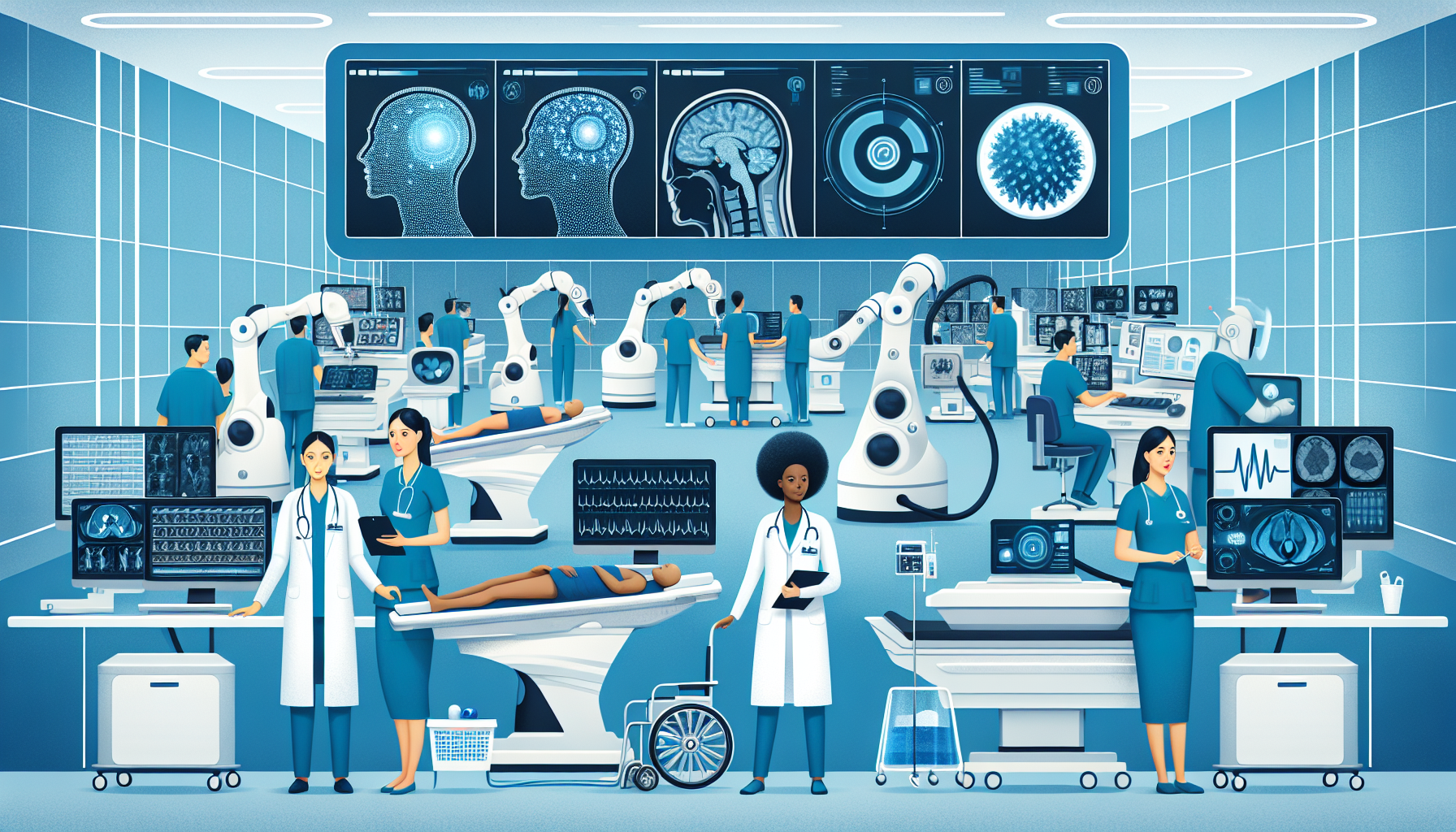

AI and Automation in Healthcare: Improving Diagnostics and Treatment Plans
The Role of AI in Healthcare Transformation
Artificial Intelligence (AI) has emerged as a cornerstone in the modernization of healthcare, significantly enhancing the accuracy and efficiency of diagnostics and treatment plans. By leveraging vast datasets and machine learning algorithms, AI continues to reshape how healthcare providers approach patient care, ultimately leading to improved health outcomes.
Enhancing Medical Diagnostics with AI
1. Image Recognition and Analysis
One of the most significant applications of AI in healthcare is in medical imaging. Algorithms trained on large datasets of medical images can recognize patterns that may escape the human eye. For instance, AI systems in radiology can analyze X-rays, MRIs, and CT scans to identify early signs of diseases such as cancer, fractures, or abnormalities in organs.
Notably, studies have demonstrated that AI-assisted diagnostic tools can achieve accuracy rates comparable, if not superior, to radiologists. For example, a deep learning model developed for breast cancer detection has outperformed human professionals, indicating a transformative potential for early detection.
2. Predictive Analytics
Predictive analytics powered by AI has revolutionized disease prediction and risk assessment. By analyzing historical patient data, demographic information, and emerging health trends, machine learning models can forecast potential health downturns. For instance, algorithms can predict the likelihood of developing chronic conditions like diabetes or heart disease, prompting timely interventions.
Healthcare providers leverage these insights to tailor preventative measures, personalized health screenings, and lifestyle recommendations, thereby proactively managing patient health.
Streamlining Treatment Plans with Automation
3. Personalized Medicine
Personalized medicine, often referred to as tailored or precision medicine, is gaining traction through AI applications. By analyzing genetic and phenotypic data, AI systems can help healthcare providers create bespoke treatment plans. For instance, oncology has benefited greatly, as clinicians can use genomic sequencing alongside AI models to determine the most effective chemotherapy regimen for individual patients.
This patient-centric approach not only enhances treatment effectiveness but also minimizes adverse effects, as therapies are tailored specifically to each patient’s unique genetic makeup.
4. Treatment Protocol Optimization
AI and automation streamline treatment protocols by analyzing vast clinical data sets to identify the most effective treatment pathways. Machine learning algorithms can evaluate treatment outcomes across a population, allowing healthcare providers to develop evidence-based protocols for diverse health conditions.
Moreover, AI tools can assist in real-time decision-making, providing clinicians with insights into the risks and benefits of various treatment options. This support aids in delivering evidence-based care, ensuring that patients receive the most effective interventions possible.
Enhancing Operational Efficiency in Healthcare
5. Workflow Automation
AI and automation tackle the administrative burden in healthcare environments. Routine tasks such as appointment scheduling, patient triage, and billing can be streamlined through AI-driven solutions. This not only reduces human error but also frees up healthcare professionals to focus on patient care rather than clerical tasks.
Natural Language Processing (NLP) plays a key role in automating patient documentation and communications. By converting voice notes or handwritten observations into structured data, healthcare practitioners save valuable time and enhance the accuracy of medical records.
6. Telemedicine Support
AI has made significant strides in telehealth, ensuring quality care at a distance. AI-driven chatbots are increasingly being utilized to handle patient inquiries, gather health information, and perform preliminary assessments before the patient sees a doctor. This use case not only improves access but also optimizes the patient experience.
Advanced AI algorithms monitor patient symptoms and medical history via telemedicine platforms, allowing healthcare providers to offer personalized advice and follow-up care recommendations efficiently.
Challenges and Ethical Considerations
7. Data Security and Privacy
As healthcare increasingly relies on AI, data security and patient privacy remain paramount concerns. Protecting sensitive health data from cyber threats while complying with regulations like HIPAA is essential. Healthcare providers must implement robust cybersecurity measures to safeguard patient information while fully leveraging AI capabilities.
8. Bias in AI Algorithms
Another pressing challenge lies in ensuring that AI algorithms are free of bias. Machine learning models trained on non-representative datasets can result in discrepancies in treatment recommendations and diagnostics for different demographic groups. Continuous vigilance in dataset curation and algorithm validation is critical to maintaining fairness and equity in healthcare solutions.
Future Prospects: The Path Forward for AI in Healthcare
9. Continuous Learning and Improvement
As AI technology evolves, continuous learning will drive innovations in healthcare. Future systems will be able to learn from new data in real-time, adapting to emerging health trends, and dynamically improving diagnostic and treatment accuracy.
Healthcare institutions are increasingly investing in research to refine AI algorithms, creating frameworks that allow AI to learn from practitioners’ experiences and feedback, thus enhancing care quality.
10. Interdisciplinary Collaboration
Collaboration between technologists, healthcare providers, and data scientists will be critical in the advancement of AI solutions in future healthcare settings. This interdisciplinary synergy will foster the design of user-friendly AI tools that seamlessly integrate into existing workflows, promoting widespread adoption among healthcare professionals.
Conclusion: Embracing the AI-Driven Healthcare Future
As AI and automation continue to infiltrate healthcare, they hold the promise of a future where diagnostics and treatment plans are not only optimized but also personalized. By addressing challenges such as data security and algorithm bias, and by fostering interdisciplinary collaboration, the healthcare industry can fully realize the potential of AI to enhance patient outcomes. Continual investment in research, training, and ethical standards will be pivotal as we advance into an era where AI-driven solutions redefine healthcare delivery.
 English